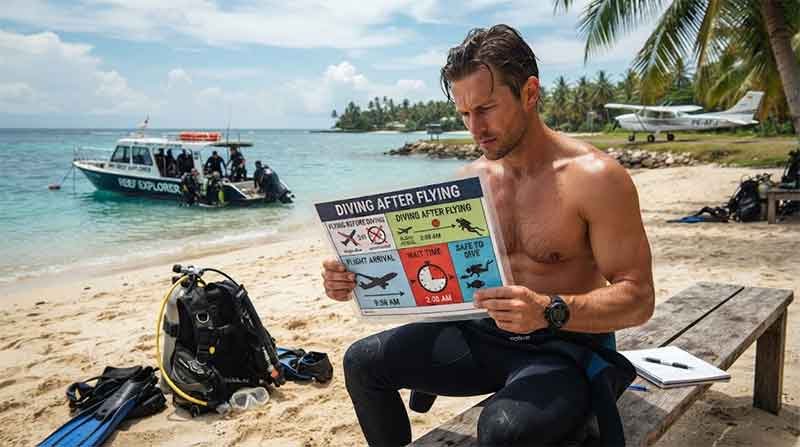
Diving After Flying: Rules Explained is one of the most important safety topics every scuba diver should understand before planning a diving holiday. Whether you are traveling to a tropical island, completing multiple dives over several days, or preparing for your return flight home, following the correct waiting period between diving and flying can significantly reduce your risk of decompression sickness (DCS).
Understanding why these rules exist, how they apply to different dive profiles, and what factors influence your safety will help you enjoy every dive with greater confidence.
Why Diving After Flying Rules Matter
Scuba diving exposes your body to increased underwater pressure, causing nitrogen from your breathing gas to dissolve into your body's tissues. During your ascent and after surfacing, this nitrogen slowly leaves your body through normal breathing.
Flying introduces another pressure change. Although commercial aircraft cabins are pressurized, they are not pressurized to sea-level conditions. Cabin pressure is generally equivalent to being at an altitude of approximately 6,000 to 8,000 feet (1,800 to 2,400 meters). This reduction in pressure can allow remaining nitrogen bubbles to expand, increasing the risk of decompression sickness.
The purpose of waiting before flying is to give your body enough time to eliminate excess nitrogen safely.
Understanding Decompression Sickness
Decompression sickness occurs when dissolved nitrogen forms bubbles inside the body due to a rapid decrease in pressure. These bubbles may affect joints, muscles, nerves, lungs, or even the brain.
Symptoms can include:
- Joint or muscle pain
- Unusual fatigue
- Dizziness
- Skin rash or itching
- Tingling or numbness
- Difficulty walking
- Shortness of breath
- Confusion
- Loss of consciousness in severe cases
Although rare among recreational divers who follow safe practices, DCS is a medical emergency that requires immediate treatment.
Why Flying Increases the Risk
After a dive, your body may still contain residual nitrogen even if you completed a normal ascent and safety stop.
Flying reduces surrounding pressure further than staying at sea level. As pressure decreases:
- Nitrogen bubbles may grow larger.
- Bubble formation becomes more likely.
- Existing microscopic bubbles may expand.
- The risk of decompression sickness increases.
The longer and deeper your dives, the more residual nitrogen remains in your tissues.
Standard Waiting Times Before Flying
The following recommendations are widely accepted for recreational scuba diving.
After a Single No-Decompression Dive
Wait at least 12 hours before boarding an aircraft.
This applies if you completed only one recreational dive within the day and remained within no-decompression limits.
After Multiple Dives or Multiple Dive Days
Wait at least 18 hours before flying.
This recommendation covers:
- Two or more dives in one day
- Diving over several consecutive days
- Most recreational dive trips
This is the recommendation followed by many dive training organizations and is considered the safest practice for recreational divers.
After Dives Requiring Decompression Stops
If you completed decompression dives or technical dives, a much longer surface interval may be necessary.
Waiting 24 hours or longer is often recommended, depending on your dive profile and gas exposure.
Technical divers should follow dive computer guidance, decompression planning software, and established technical diving procedures.
Recommendations from Major Diving Organizations
Leading diving organizations generally recommend:
- Minimum 12 hours after one recreational dive
- Minimum 18 hours after multiple recreational dives
- Longer waiting periods after decompression diving
These recommendations are based on decades of research involving dive physiology, decompression theory, and accident analysis.
When in doubt, waiting longer is always the safer option.
Factors That Affect Your Risk
Every diver absorbs and releases nitrogen differently.
Several factors can increase your decompression risk.
Dive Depth
Deeper dives expose your body to higher pressure, resulting in greater nitrogen absorption.
A dive to 30 meters (100 feet) generally leaves more dissolved nitrogen than a dive to 10 meters (33 feet).
Dive Duration
Long dives allow more nitrogen to dissolve into body tissues.
Even shallow dives can lead to significant nitrogen loading if they last a long time.
Multiple Consecutive Dives
Residual nitrogen accumulates over multiple dives.
Liveaboard trips and dive vacations often involve several dives every day, making proper planning before flying even more important.
Cold Water
Cold temperatures can affect circulation and may influence nitrogen elimination.
Divers often use thicker exposure protection, which can also contribute to fatigue.
Hydration
Dehydration may increase decompression risk.
Drink plenty of water before and after diving while avoiding excessive alcohol.
Physical Condition
Good overall health supports normal circulation and recovery.
Fatigue, illness, obesity, smoking, and poor physical fitness may increase decompression risk.
Can You Dive Immediately After Flying?
Many divers wonder whether flying to a destination and diving the same day is safe.
In most cases, recreational diving shortly after arriving by airplane is acceptable because commercial flights do not cause significant nitrogen loading like scuba diving does.
However, you should consider:
- Jet lag
- Fatigue
- Dehydration
- Motion sickness
- Lack of sleep
If you feel exhausted after a long international flight, resting before your first dive is often the better choice.
Why Dive Computers Cannot Replace Flying Guidelines
Modern dive computers continuously calculate nitrogen loading throughout your dives.
Some computers even display a "No Fly Time."
However, not every dive computer uses the same decompression model.
For this reason:
- Follow the longer recommendation if uncertain.
- Never ignore your computer's no-fly countdown.
- Consider additional waiting time if your dives were close to no-decompression limits.
When multiple recommendations exist, choosing the most conservative option improves safety.
Special Considerations for Liveaboard Trips
Liveaboards often include:
- Three to five dives daily
- Night dives
- Several consecutive diving days
This results in higher cumulative nitrogen exposure.
Many liveaboards schedule the final dive at least 24 hours before guests depart for the airport.
This schedule provides an additional safety margin.
Mountain Travel After Diving
Flying is not the only situation involving altitude.
Traveling by car to mountain destinations after diving can also expose you to lower atmospheric pressure.
Examples include:
- Driving through high mountain passes
- Visiting elevated volcanoes
- Traveling to high-altitude towns
These activities should be planned with the same caution as flying.
If your post-dive travel involves significant altitude, discuss your plans with your dive operator before diving.
Practical Tips for Planning Dive Holidays
Good planning helps avoid unnecessary stress before your flight home.
Some useful habits include:
- Schedule your last dive the day before departure whenever possible.
- Avoid squeezing in "one final dive" on departure day.
- Stay well hydrated.
- Get enough sleep during your dive trip.
- Keep detailed dive logs.
- Follow your dive computer's recommendations.
- Listen carefully to dive briefings.
- Build extra time into your travel schedule.
A relaxed itinerary is almost always safer than a rushed one.
Common Myths About Diving and Flying
Myth 1: If I Feel Fine, I Can Fly Immediately
Symptoms of decompression sickness may not appear immediately.
Feeling normal does not guarantee all nitrogen has safely left your body.
Myth 2: A Safety Stop Eliminates All Risk
Safety stops significantly reduce decompression stress but do not completely eliminate residual nitrogen.
Waiting before flying remains necessary.
Myth 3: Short Dives Require No Waiting Time
Even shallow recreational dives leave some dissolved nitrogen in the body.
Waiting periods still apply.
Myth 4: Drinking Water Removes Nitrogen Faster
Proper hydration supports healthy circulation, but it does not dramatically speed nitrogen elimination.
Time remains the primary factor.
What Happens If You Ignore the Waiting Period?
Flying too soon after diving can increase the chance of:
- Decompression sickness
- Emergency medical treatment
- Hyperbaric chamber therapy
- Trip interruption
- Hospitalization
- Permanent injury in severe cases
Although many divers may fly early without experiencing problems, the increased risk is unnecessary and avoidable.
Signs That Require Immediate Medical Attention
Seek emergency medical care if symptoms develop after diving or during travel.
Warning signs include:
- Severe joint pain
- Numbness
- Weakness
- Balance problems
- Difficulty breathing
- Chest pain
- Confusion
- Vision changes
- Paralysis
- Loss of consciousness
Inform healthcare providers that you recently completed scuba dives, as this information is critical for proper diagnosis.
Frequently Asked Questions
Can I fly 12 hours after one recreational dive?
Yes, this is generally considered the minimum recommended waiting period after a single no-decompression dive.
Is 18 hours enough after several dives?
For most recreational divers completing multiple dives or several dive days, 18 hours is the commonly recommended minimum. Waiting longer provides an additional safety margin.
Should I wait 24 hours if possible?
Absolutely. Even though many recreational divers only need to wait 18 hours, extending the interval to 24 hours offers extra peace of mind.
Can private airplanes be different?
Yes. Small aircraft may fly at higher cabin altitudes or may not be pressurized, increasing decompression concerns.
Does Nitrox change flying rules?
Although Nitrox reduces nitrogen exposure compared to air when used correctly, standard no-fly recommendations should still be followed unless directed otherwise by recognized diving procedures.
Final Thoughts
Diving After Flying: Rules Explained is essential knowledge for every recreational and technical diver. The waiting period before flying is not simply a recommendation—it is a proven safety practice designed to reduce the risk of decompression sickness. Whether you complete a single dive, spend several days exploring coral reefs, or enjoy an intensive liveaboard adventure, allowing sufficient time for your body to eliminate excess nitrogen is one of the easiest ways to protect your health. By planning your travel schedule carefully, following your dive computer, staying hydrated, and waiting the recommended amount of time before boarding your flight, you can end every diving holiday safely and confidently.
Related Posts: